
When you look at Hollywood storytelling, it’s almost banal to notice that every hero, without exception, is sentenced to serious suffering. From Aristotelian plot structures all the way to today’s blockbusters, pain is the glue that sticks us to the protagonist. Through that ordeal we move closer to the hero, build an intimate identification, and at some point quietly start to read our own life into their arc.
Joseph Campbell would say this is our mythological inheritance: the hero’s trial is not a screenwriting trick, it’s an anthropological habit. Christopher Vogler takes Campbell’s toolbox, repackages it for development executives, and underlines the same point: the kind and intensity of suffering you assign to your hero is not only a thematic choice, it is a box-office variable (Vogler, 2007: 12).
So when we say “posthuman narrative” and immediately think of cyborgs, we’re not just talking about chrome, circuitry, and neon-blue HUDs. We’re talking about whether this very old template for suffering can still function once the body is no longer fully “human” and the hero’s subjectivity is wired into metal and code.
Posthuman imagery shows up most loudly in science fiction. Together with industrialization, it gave us that long-standing fantasy of “the metal future” as humanity’s final destination. To make that fantasy even vaguely plausible, capitalism did what it always does: turned it into content, put a price on the ticket, and let the entertainment industry siphon the R&D budget directly out of our popcorn money.
And here’s the funny part: there is an entire historical period that, technologically, hasn’t really been surpassed yet. The Second World War. The same war that saw radical advances in rocketry, computing, nuclear physics—also terrified the profit centres. If we kept going at that speed, the planet might end before the quarterly reports did. Once the atom bomb actually went off, someone in the boardroom essentially said: “Okay, maybe let’s not annihilate our own customer base.”
So the Cold War arrives as a compromise. Everybody will test their toys in their own desert, flex in front of each other, and while the world balances on the edge of annihilation, we’ll quietly pivot the technology toward prolonging life rather than ending it. That, however, requires immense capital. The owners of that capital would prefer to party, believe in their own immortality, and then die suddenly and confused.
That’s why cinema exists. Among other things, it’s the machine that lets us fantasize about the future, normalize it, and finance it—while telling ourselves we’re just out for a fun night at the movies.
“Even a Cyborg Is Still Human”: Posthuman Ordeals
First of all, there are the robots. Big, beautiful, sublime machines. These robots are not meant to ride off “on those fine horses into the sunset” and vanish. Then along comes artificial intelligence—at first just a chess engine, a machine that can embarrass a grandmaster. But in narrative terms, AI quickly mutates into a kind of hostile mirror: something that will eventually surpass us, judge us, and, if not destroy us, at least look back in disgust and walk away.
So the compromise solution becomes hybridity. Half robot, half human—but in mainstream cinema, almost always majority American.
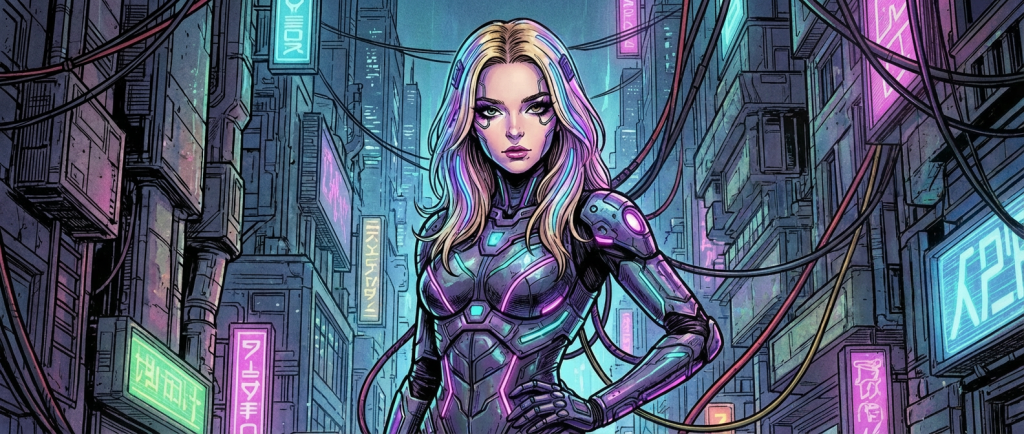
When we say “posthuman,” a very broad spectrum opens up, from genetic modification to uploading consciousness. Here I’m narrowing the field: I’m interested specifically in cyborg figures—bodies that drift from the organic toward metal, where the brain remains biological but rules over a constructed body.
Donna Haraway’s cyborg manifesto imagines precisely this hybrid being as something that dissolves boundaries: female/male, human/machine, nature/technology start to lose their sharp edges. In that universe, the classic mythological threat of castration doesn’t map neatly anymore. If, following Freud, we take the upright human figure as a metonym for the phallus, then the head still remains symbolically “exposable” to castration. But once we are dealing with cyborgs, we are also dealing with alternative infrastructures of memory and identity. Consciousness can be stored, copied, uploaded; the body is no longer the sole hostage.
In other words, the posthuman hero still suffers—but the forms of suffering mutate. The wound moves from flesh to firmware, from oedipal drama to version conflict. Let’s look at some of these in-between beings and at the particular flavours of ordeal that come with being neither fully human, nor fully machine.
Alone in Your Empty Home, You Bore an Unbearable Burden
Start with Darth Vader. Anakin Skywalker’s transformation into Vader is practically a catalogue of heroic suffering: catastrophic bodily injury, burned flesh, amputations, and the transition into a full-blown cyborg suit. Behind the black armour there is a man who has lost his wife, been separated from his children, and sentenced to experience “family” only as a ghost of a possibility. His final reconciliation with his son happens at the precise moment he is dying in that son’s arms. The emotional closure and physical extinction are synchronized.
Alex Murphy in RoboCop is another textbook case. After the shootout, only a head and one arm survive. The rest is corporate hardware. In the second film, when his body is literally dismantled and reassembled, the real drama is not mechanical. It’s his internal conflict over being cut off from his wife and child: the awareness that in the eyes of the company—and by extension, the law—he is no longer a person, just intellectual property with a gun attached.
In Ghost in the Shell, Motoko’s ordeal is similarly framed through loss. In the 2017 Hollywood version she is haunted by the loss of her family and, within the narrative, also loses Dr. Ouelet, the scientist who functions as a kind of creator-mother figure. In the climactic scenes, her prosthetic arms are torn off as she tries to save Kuze, her former lover, whose own existence is a glitch in the system. In the original anime, she goes even further: she loses not just her arms but her entire body, ending up in a second-hand child shell. The heroic trial is not only “can I survive this battle?” but “can I still retain a coherent ‘I’ when my body is endlessly replaceable?”
In Terminator Salvation, Marcus is a hybrid whose lack of family becomes part of the interrogation: his body is torn apart by Connor’s forces, and his very right to exist is questioned. In later entries, the twist is even crueller. John Connor, already marked by the absence of his father and the impossible demands of his mother, chooses hybridity as a survival strategy—only to be re-coded as the villain and eradicated. The narrative punishes him not for being evil, but for daring to occupy the space between categories.
When we move to fully artificial intelligences, the pattern shifts but doesn’t disappear. In Ex Machina, Ava kills Nathan—the closest thing she has to a “father”—not out of mythic oedipal hatred, but because refusing to kill him means accepting her own execution. Freedom requires killing the family. She crosses that threshold and walks into the crowd, literally blending into humanity.
In A.I. Artificial Intelligence, David is abandoned by his foster family and spends the entire film chasing a fantasy mother. His ordeal seems to end in an ice-cold death at the bottom of the ocean, frozen in front of the Blue Fairy. Only thousands of years later is he revived by a posthuman civilisation that grants him one simulated day with a recreated mother. His wish is fulfilled, but only after history has ended.
In Luc Besson’s Lucy, the protagonist is already a migrant, already uprooted. A synthetic drug rewires her biology and accelerates her into something like a supermassive intelligence. As she ascends, she sheds her body entirely, leaving behind only a data-object—a black monolith of sorts—that connects her to all networks. Her ordeal is the price of transcendence: in becoming everything, she forfeits the right to be someone.
Across all these examples, the pattern is obvious: posthuman heroes and heroines are structurally homeless. They are separated from parents, children, partners; their “families” are killed, corrupted, or revealed to have been exploiting them all along. Their bodies become battlegrounds where this exile is written in metal and scar tissue.
Please Don’t Leave Me, Loneliness Hurts So Much
The common thread is blunt: these rootless heroes are all deprived of family. In my previous work I leaned on Otto Rank’s analysis. In The Myth of the Birth of the Hero, Rank notes that in classical myths the hero almost always comes from a noble house; he is usually the king’s son (Rank, 2004: 74). The whole point is that he has a claim to the throne.
In posthuman cinema, our hybrid heroes are almost never princes by blood. They are ordinary people, often dispossessed, sometimes criminalized. That’s not accidental. Precisely because they are structurally “nobody,” they can kill the king—the Father—without the full force of the oedipal curse falling on them. The symbolic royal blood they need is externalised into corporations: the companies that build their new bodies take over the role of the noble house. Corporate logos replace coats of arms.
This way, the hero’s blue blood comes from the brand, not the bloodstream. The hybrid hero becomes both experiment and product.
However, modern narrative structures are not particularly tolerant of in-between states. The system of binary oppositions that undergirds modernity—human/machine, nature/technology, male/female—wants clear slots, not ambiguous intermediaries. So the hybrid hero must be punished.
That’s why so many cyborg or hybrid protagonists end up mutilated, dead, absorbed, or exiled. The message, encoded in spectacle, is simple: if you refuse to choose a side, the story will choose for you—and you will not like the outcome.
There is a telling contrast here. Ava, David (A.I.), Lucy—figures who are already “pure” in some sense (fully artificial, fully synthetic, or fully transcendent)—are allowed something like a happy ending, even if it’s weird, melancholic, or open-ended. The fully human and the fully artificial can be stabilized into a moral category. The problem, the real tension, lies in the hybrid zone.
Modern posthuman narratives, built on the same binary logic as the systems they critique, smuggle a convenient lie into the audience’s unconscious: hybridity equals punishment. The in-between position, the refusal of clear identity coordinates, is dangerous and will be disciplined. Terminator Genisys pushes this to absurdity by turning John Connor himself into the shadow archetype—a warning that even thinking about merging with the machine will put you on the wrong side of the gun.
And while all this ideological work is being done, the distribution of real-world resources continues as usual. The limited assets of the planet are reserved—discursively and materially—for “the select few.” Everyone else watches stories of broken cyborgs and tragic hybrids, experiences catharsis, and then returns to their underpaid, over-surveilled lives a little more resigned.
Cinema, once again, does its job.
References
Campbell, J. (2008). The Hero with a Thousand Faces (3rd ed.). New World Library.
Freud, S. (1965). Introductory Lectures on Psycho-Analysis (J. Strachey, Trans.). W. W. Norton.
Haraway, D. (1991). “A Cyborg Manifesto: Science, Technology, and Socialist-Feminism in the Late Twentieth Century.” In Simians, Cyborgs, and Women: The Reinvention of Nature. Routledge.
Rank, O. (2004). The Myth of the Birth of the Hero: A Psychological Exploration of Myth (G. C. Richter & E. J. Lieberman, Trans.). Johns Hopkins University Press.
Vogler, C. (2007). The Writer’s Journey: Mythic Structure for Writers (3rd ed.). Michael Wiese Productions.

 filmoctopus