
By the Filmoctopus Team
When the Lumière Brothers first presented The Arrival of a Train at La Ciotat (1895), legend has it that the audience ran out of the theater in terror. The technology of that day was such a powerful representation of reality that human perception struggled to process it. Today, more than 130 years later, we stand at a similar breaking point. But this time, it is not a train rushing towards us; it is a massive digital wave composed of Artificial Intelligence (AI), Virtual Reality (VR), and algorithmic narratives.
As cinema leaves the first quarter of the 21st century behind, it is transitioning from the classical era of “recording reality” to the post-cinema era of “reconstructing reality digitally.” So, what will this transition change, from mise-en-scène to genre, from runtime to exhibition practices? As Filmoctopus, we are putting the probable future forms of cinema on the table.
1. The Revolution of Mise-en-scène: The “Post-Camera” Era
In traditional cinema, mise-en-scène was the physical arrangement of decor, costume, lighting, and acting in front of the camera. However, new technologies are transforming the concept of the “camera” from a physical optical device into a virtual “viewport.”
Virtual Production and “The Volume” The artificial feeling created by Green Screen technology and the problem of actors playing to a void have been overcome by LED wall technologies (The Volume), popularized by productions like The Mandalorian and The Batman. Directors and cinematographers no longer have to chase the “Magic Hour.” Light reflects naturally from massive LED panels on set. This elevates control over mise-en-scène to a god-like level. The location is now a dynamic scene element that can be changed live around the actor.
Generative AI and Images “Created from Nothing” Tools like OpenAI’s Sora or Runway Gen-2 have made the transition from text-to-video possible. This is revolutionary for independent filmmakers. A sci-fi city or an uncanny horror atmosphere, which used to require a million-dollar budget, can now be created with the right “prompt engineering.” This situation transforms cinema from an “art of recording” into an “art of construction,” much like painting. André Bazin’s theory of the “mummy complex” is collapsing because there is no longer a necessity for a physical reality to be mummified.
2. Hybridization of Genres and New Aesthetics
Technology changes not only how films are made but also what stories are told and how those stories look.
The Infiltration of Game Aesthetics With game engines like Unreal Engine 5 settling into the heart of the film industry, the boundary between cinema and video games is blurring. Camera angles become more “fluid,” and action sequences defy the laws of physics. The FPS (First Person Shooter) perspective tested with Hardcore Henry may become a standard narrative language in future films watched with VR headsets.
“Screenlife” and Desktop Thrillers The “Screenlife” genre, introduced into our lives with films like Searching or Unfriended, is a narrative form that takes place entirely on computer or phone screens. Considering we spend most of our lives looking at screens, this genre is inevitably becoming the “realistic drama” of the future. Our digital footprints are becoming the main setting for new-generation detective films.
3. Exhibition Methods: From Collective Experience to Hyper-Personalization
Is the movie theater dying? No, but the act of “going to the movies” is changing meaning. Movie theaters are transforming into “premium” and ritualistic experience spaces, much like operas or theaters.
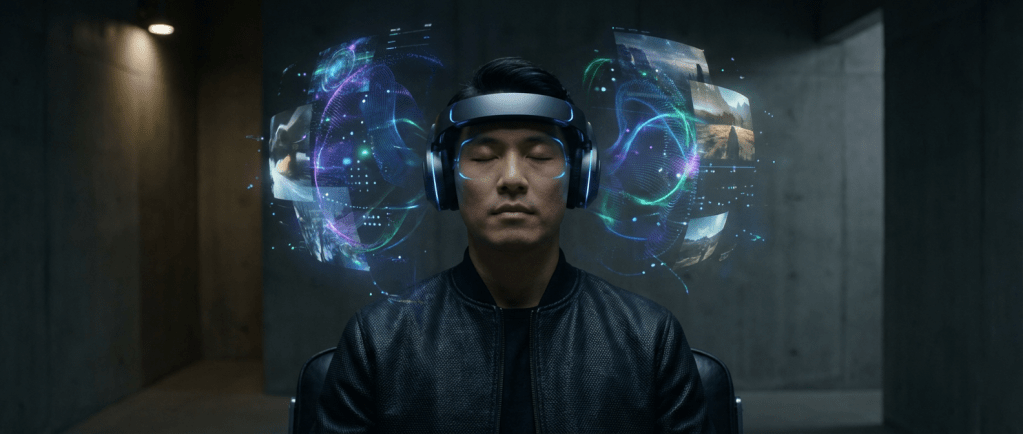
Boutique Theaters vs. Neuro-Cinema While technologies like IMAX, Dolby Atmos, and 4DX will keep theaters alive by offering experiences that cannot be mimicked at home, things are changing on the individual front. Mixed Reality headsets like the Apple Vision Pro promise the viewer an “infinitely large screen.” Looking even further ahead, brain-computer interfaces like Elon Musk’s Neuralink signal that future films will not just be watched but “felt.” Bio-feedback films that change the tempo of a scene based on your heart rate in a horror movie are about to cease being science fiction.
4. Runtime Standards and the Attention Economy
For most of cinema history, films were squeezed between 90 and 120 minutes due to commercial/physical constraints like reel lengths and theater showtimes. Streaming platforms have shattered this rule.
The Dual Structure: Micro-Cinema and Mega-Epics We are seeing a divergence into two extremes. On one side, there is Micro-Cinema: high-production, punchy “micro-movies” (10-20 minutes) catering to attention spans shortened by TikTok and Instagram Reels. On the other side, there are Mega-Epics: massive productions lasting 4-5 hours, like Scorsese’s Killers of the Flower Moon or the Snyder Cut, which feel no pressure from theater schedules.
In the future, the concept of “film runtime” may be replaced by the concept of a “content universe.” The audience might decide whether to stay in a story for 2 hours or interact with spin-offs for days.
5. Screenwriting: Algorithmic Creativity or Human Genius?
Perhaps this is the most controversial area. Big Data knows exactly at which minute the viewer gets bored, which color palette they love, and which actor combination they react to. Platforms like Netflix use this data to try and produce “guaranteed” hits.
We can foresee that future scripts will be written through a collaboration (or conflict) between the emotional intelligence of human writers and the data analytics of AI. AI might find logical inconsistencies in the plot or suggest thousands of alternative endings; however, creating that indescribable conflict—catharsis—in the depths of the human soul seems to remain in human hands.
Conclusion: The Ghost in the Shell
As technology advances, cinema will evolve into a form where the “human factor” is not diminished but rather becomes even more valuable. In a world where everyone can produce flawless, photorealistic images; flaws, personal perspectives, the writer’s “voice,” and human errors will become more precious.
Technology changes the brush in the filmmaker’s hand; it turns it into a laser, a hologram. But as long as the hand holding that brush and the soul reflecting on the canvas continue to tell a story, cinema will not die; it will only be reborn. As Filmoctopus, we will continue to watch this new world beyond the curtain with excitement.

 filmoctopus